Have this ever happened to you?
- Ever become suddenly angry at someone and done things that you regret?
- Ever been aware while a situation was unfolding that you want to behave differently?
- Do you find yourself unable to avoid the same unfortunate situation?
- Found yourself addicted to food, drugs, or sex?
Introducing Miggy and Courtney
How is it possible to lose control of yourself? How can you find yourself an observer while it seems that someone else has taken control of you?
We talk about the mind as if it is one thing, but the reality is that here are at least two parts to the mind. Just like we use the term car as a single thing doesn't prevent it from being composed of an engine, passenger compartment, trunk, etc.
One of the oldest parts of the brain is the amygdala (Miggy for short); it is responsible for the flight or fight response when we are exposed to danger. Miggy receives all stimulus (visual, auditory, etc) from the outside world and if it perceives patterns of danger then it goes into fight/flight, otherwise it does nothing.
We used to live in a dangerous world, so Miggy's behaviour is what kept the human race from extinction. It is a good thing to react to dangerous stimuli and take action to fight or flee.
We used to live in a dangerous world, so Miggy's behaviour is what kept the human race from extinction. It is a good thing to react to dangerous stimuli and take action to fight or flee.
In a modern world we are not facing dangerous like tigers and lions. Instead, we react to criticisms, insults, and other things as if they were real dangers. There is plenty of literature on this, so I won't go into it (see 'Amygdala hijack').
Miggy is designed to give you fast answers based on simple pattern recognition. Miggy leads you to make the same decisions when you get the same stimulus:
- You see food that you like and you get hungry
- You see someone attractive and you want to stare at them
- Someone cuts you off with their car and you get angry
The thinking part of your brain that can sort out impressions and come to conclusions is the prefrontal cortex (Courtney).
Survival depends on fast decisions to danger, otherwise, you can be hurt or killed before you have a chance to react (see Dodo). This is why Courtney is not in control of the bus. Miggy gets first crack at inputs to the brain because he can can save your life in the presence of danger, however, if he starts executing, then Courtney becomes a passenger along for the ride.
When Miggy decides not to do anything then Courtney gets a crack at what to do next. Courtney is the part of the mind that can think through situations, look at alternatives. The problem is that Courtney is very, very slow compared to Miggy.Situations that get you angry or cause you to react and 'lose control' are all situations where Miggy has sprung into action leaving Courtney as a passive observer. When Miggy is no longer in control, i.e. the threat has passed, Courtney reasserts control and this is when you experience regret.
The worst thing is that Courtney is aware when an automatic reaction by Miggy is taking place. Sometimes you know how you are going to react, but feel that you are powerless to stop it.
What Does This Mean?
It is important to know how Miggy is programmed in the first place and then what it takes to get bad habits out.
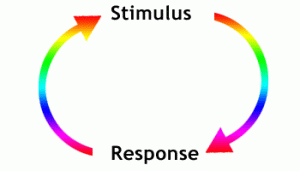 Every time you receive a stimulus the mind dissects the patterns and stores the information. This is why you never get a chance to make a second impression, there is always some part of the first impression that is stored up. So any bad first impression will take quite a bit of sustained effort to make it go away.
Every time you react to a situation, especially negatively through anger, Miggy records this. Every time you have the same angry reaction to the same stimulus you reinforce Miggy and make it that much easier for you to have the exact same reaction when the situation presents itself again.
For example, the first time that you have an angry reaction to a situation there is generally some confusion and Courtney has a crack at preventing you from getting angry. If you give in to the anger then the impression is registered. If you give in enough then Miggy will always take over in those situations and you will always get angry.
However, each time you give in to Miggy and become angry it becomes more ingrained. You will find yourself getting angry faster and faster when presented with stimuli that frustrate you. Frustration leads to anger, anger leads to violence.
Any activity that you repeat often and automatically will get driven into your amygdala. Each time you do this you give more control to Miggy.
What Can You Do?
The only way to get Courtney back in control is to go through a process of recognizing dangerous stimuli before Miggy takes action and choosing not to take action. This is really hard.
The reality is that you need to go through the following process:
The reality is that you need to go through the following process:
- Miggy springs into action and Courtney recognizes it afterwards
- Courtney is aware that Miggy is acting but can't intervene
- Courtney becomes aware that Miggy will act but chooses not to stop Miggy
- Courtney is able to prevent Miggy from acting
Point of No Return
Most people are not even aware that they are ceding control of Courtney to Miggy. But the more you allow Miggy to take control the harder it gets to take control back.
The point of no return is where a stimulus causes an automatic reaction where Courtney is not even aware that the action is taking place, such as:
- Something contradictory happens and you get angry immediately
- You see a particular food and you must eat it
- You see an attractive person and then your mind is consumed by them
- You are taking drugs compulsively
Once you hit the point of no return it is virtually impossible for Courtney to reassert control. Short of hitting rock bottom where you realize the sheer danger of the automatic action, you will have lost control.
After Thought
We all develop behaviours or buttons for automatic behaviour as we get older. But unless we are vigilant and keep Courtney firmly in control, we will eventually cede control in some situations to Miggy, and will then have to live with the consequences of automatic actions.